 Josh Reid
Projects Don’t Fail Overnight
From the outside, a delayed project can look like poor execution or lack of effort. But in reality, most projects fall behind gradually—through small missteps that compound over time.
Deadlines slip. Priorities shift. Communication breaks down.
And before anyone realizes it, the project is off track.
For business owners and operational leaders, this creates more than just frustration—it impacts revenue, client relationships, and team morale.
The Real Reasons Projects Fall Behind

1. Misalignment Between Stakeholders
When leadership, marketing, and execution teams aren’t aligned, confusion follows.
- Goals are interpreted differently
- Priorities compete instead of reinforce
- Decisions take longer than they should
Without alignment, even strong teams struggle to move efficiently.
2. Unclear Ownership
One of the most common breakdowns in project delivery is simple:
👉 No one clearly owns the outcome.
Tasks get passed around. Accountability gets diluted. And progress slows.
Strong account management ensures every deliverable has a clear owner—and that nothing falls through the cracks.
3. Communication Gaps
It’s not that communication isn’t happening—it’s that it’s inconsistent or ineffective.
- Updates are reactive instead of proactive
- Important context gets lost
- Teams operate with partial information
This leads to rework, missed expectations, and timeline delays.
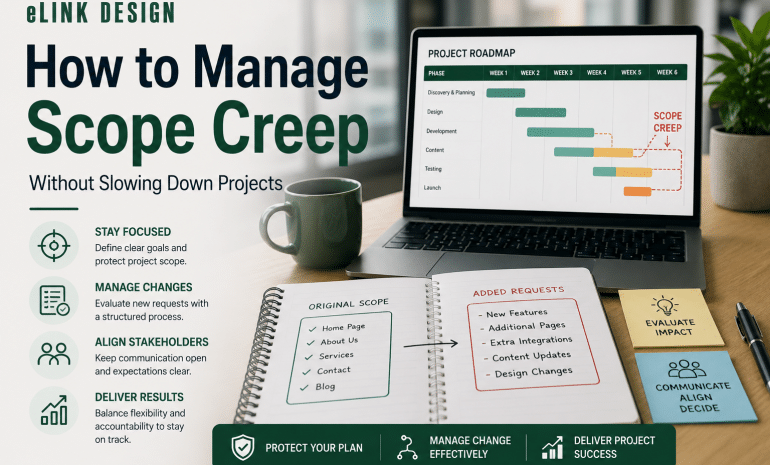
4. Scope Creep Without Structure
Scope changes are inevitable. Poorly managed scope changes are not.
Without a structured process:
- Small additions accumulate
- Timelines stretch without adjustment
- Teams become overloaded
This is where structured digital project workflows help maintain balance between flexibility and control.

At a certain level of complexity, many organizations find that internal coordination alone becomes difficult to sustain—especially when managing multiple stakeholders, timelines, and systems.
This is often where having a partner experienced in account management for digital projects can help bring clarity, structure, and consistency to ongoing work.
Where Account Management Makes the Difference
Strong account management doesn’t just “manage the client”—it connects strategy, execution, and communication.
Alignment Across Teams
An effective account manager ensures everyone is working toward the same outcome.
They translate business goals into actionable direction for internal teams—reducing friction and confusion.
Clear Communication Loops
Instead of scattered updates, communication becomes structured and intentional.
- Regular check-ins
- Clear reporting
- Defined escalation paths
This keeps everyone informed and reduces surprises.
Proactive Problem Solving
Rather than reacting to delays, strong account management anticipates them.
- Identifies risks early
- Adjusts timelines when needed
- Keeps stakeholders aligned through change
This proactive approach is often the difference between a minor adjustment and a major delay.
The Role of Process (and Where AI Fits In)
Modern project environments are more complex than ever. Teams are distributed, timelines are tighter, and expectations are higher.
Process Creates Predictability
Defined workflows ensure that:
- Tasks move consistently
- Dependencies are visible
- Progress is measurable
Without process, even experienced teams struggle to scale.
AI Enhances Visibility and Efficiency
AI-powered tools can support account and project management by:
- Summarizing meeting notes and action items
- Flagging potential delays based on patterns
- Automating status updates and reporting
While AI doesn’t replace human oversight, it reduces administrative friction and allows teams to focus on higher-value work.

How to Keep Your Projects on Track
If projects are consistently falling behind, the solution isn’t just working harder—it’s working more intentionally.
Start with:
- Clear ownership of every deliverable
- Structured, proactive communication
- Alignment between business goals and execution
- Defined processes for managing scope and change
And most importantly:
👉 Ensure someone is responsible for connecting all of these pieces.
That’s the role of strong account management.
Final Thoughts
Projects rarely fail because teams lack skill or effort. They fall behind because of gaps—gaps in alignment, communication, and ownership.
By strengthening account management and supporting it with the right processes, tools, and ongoing website support -businesses can turn project delivery into a competitive advantage.
At eLink Design, we help organizations improve alignment, streamline communication, and manage ongoing digital initiatives more effectively across teams and systems.
If your projects are consistently falling behind, it may not be a workload issue—it may be a structure issue.
Connect with eLink Design to learn how stronger account management and project workflows can help keep your initiatives on track.