
 Mauro Garcia
The Quality of AI Depends on the Context It Finds
AI systems are only as useful as the information they retrieve before answering.
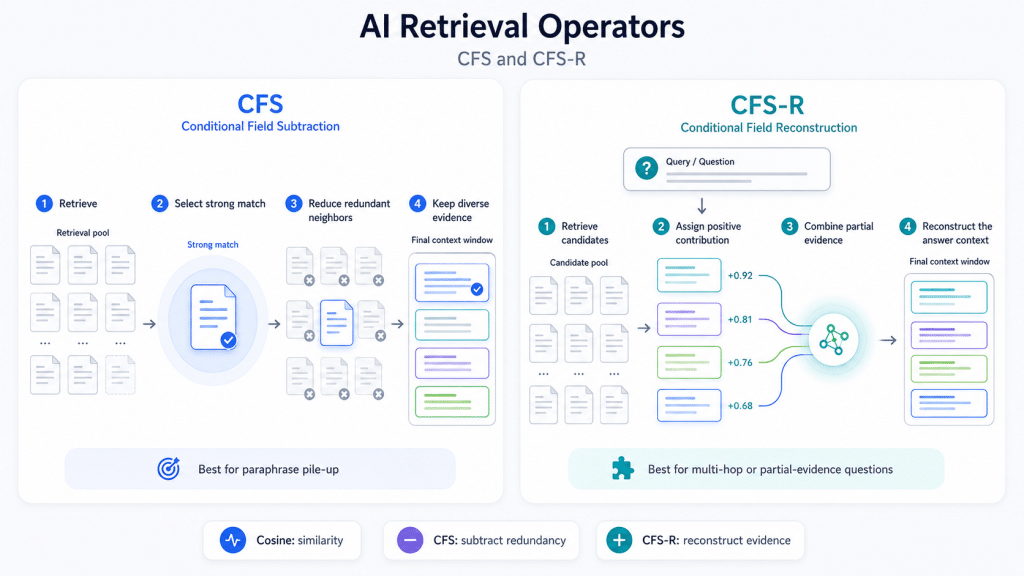
Most modern AI tools do not work from everything they know at once. They search through documents, conversations, notes, tickets, or records, pull in relevant information, and then generate an answer from that context.
When retrieval works well, AI feels accurate, helpful, and aware of the bigger picture.
When retrieval works poorly, AI may miss important details, repeat the same information, or give an answer that sounds confident but lacks the right supporting evidence.
This is the problem CFS and CFS-R were designed to improve.
What Problems Do CFS and CFS-R Solve?
Traditional AI retrieval often relies on similarity.
In simple terms, the system asks:
What information looks closest to this question?
That works well in many cases, but it can also create problems.
For example, if someone asks:
Why did this project go over budget?
A basic retrieval system may return several results that all mention the budget:
- The project was over budget
- The budget changed
- The budget was discussed
- The client asked about the budget
Those results are related, but they may not explain the full situation.
The better answer may require different pieces of evidence:
- A vendor quote changed
- A delivery delay added labor
- The client requested extra features
- The timeline shifted
AI needs more than repeated mentions of the same topic. It needs useful context.
That is where CFS and CFS-R come in.
What Is CFS?
The simplest way to explain it is:
- CFS stands for Conditional Field Subtraction.
- It was designed to help AI avoid wasting context space on repeated versions of the same information.
In many AI systems, only a limited number of documents, notes, or memories can be sent into the model at once.
Every slot matters.
Standard search can sometimes fill those slots with near-duplicates. CFS helps reduce that repetition by giving preference to information that adds something new.
Instead of only asking:
• Is this relevant?
CFS also asks:
• Does this add useful context we have not already covered?
That makes the final answer stronger because the AI receives a better mix of supporting evidence.
CFS vs. CFS-R
CFS and CFS-R are related, but they solve different retrieval problems.
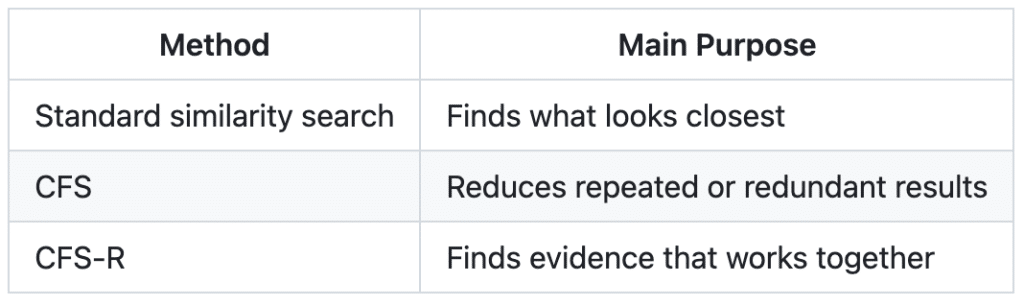
Used together, they help AI systems retrieve stronger context before generating a response.
That can make AI more useful across long conversations, large document sets, support histories, project notes, and internal knowledge bases.
Why This Matters for Business AI
Business data is messy.
Teams repeat themselves. Clients restate the same issue in different ways. Meeting notes mention the same decisions multiple times. Support tickets circle around the same problem.
Without better retrieval, AI can focus too much on one repeated cluster of information while missing the detail that actually matters.
That can lead to:
• Incomplete answers
• Missed project context
• Repeated recommendations
• Weak summaries
• Lower trust in AI-generated output
Better retrieval helps AI systems produce responses that are more grounded, more complete, and more useful.
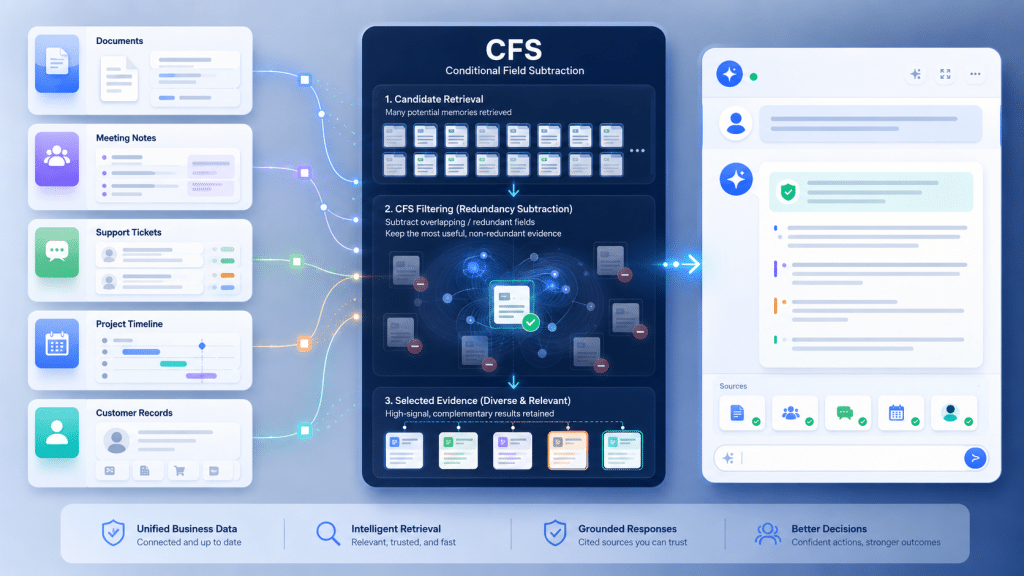
How Smarter Retrieval Improves AI Outcomes
A stronger retrieval system can help AI tools:
• Find more complete context
• Avoid repeated evidence
• Surface overlooked details
• Handle long histories more effectively
• Answer multi-step questions more accurately
• Create better summaries and recommendations
For businesses, this can improve internal workflows, client communication, customer support, project visibility, and documentation.
The model is only one part of the system.
The surrounding architecture matters too.
Even a powerful AI model can struggle if the wrong information is retrieved first.
Key Takeaways
CFS helps AI avoid wasting context on repeated information.
CFS-R helps AI find pieces of evidence that work together.
Traditional similarity search is useful, but it can miss important context in long histories or large knowledge bases.
Better retrieval improves the quality, accuracy, and usefulness of AI-generated responses.
For businesses, the future of AI is not just better chatbots. It is smarter systems that can retrieve, reason, and respond with the right context.
Final Thoughts
AI systems are becoming more powerful, but power alone is not enough.
For businesses, real value comes from AI that understands context.
That means retrieving the right information, avoiding unnecessary repetition, and surfacing the evidence that actually supports the answer.
CFS and CFS-R were built around a simple idea:
AI retrieval should not only find what looks similar.
It should find what is useful.
As businesses continue adopting AI across operations, support, sales, onboarding, and internal workflows, retrieval quality will become one of the biggest factors separating generic AI tools from truly effective AI systems.
Connect with eLink Design to build smarter AI systems grounded in your data, your workflows, and your business goals.
Resources
Paper on CFS
Paper on CFS-R