 Mauro Garcia
Artificial intelligence has changed the way we build software, and it’s happened incredibly fast.
Today, developers can generate entire components, refactor complex functions, and build working applications with just a few prompts. Tasks that once took hours can sometimes be accomplished in minutes.
At eLink Design, we’re always exploring how emerging technologies can improve the way we design, develop, and maintain software. AI has created some incredible opportunities to make development faster, reduce repetitive work, and help our teams focus on solving more complex problems.
But as these tools become increasingly capable, there’s an important distinction that we believe deserves more attention.
Just because we can generate code faster doesn’t mean we understand it better.
And when you’re building software that businesses depend on, that understanding matters.
The Difference Between Writing Code and Understanding It
Modern software applications are rarely simple. Even a relatively small change can involve multiple services, dependencies, integrations, and architectural decisions.
Understanding a function isn’t always as straightforward as reading through its code. Developers need to understand what calls it, what depends on it, why certain decisions were made, and what might happen elsewhere in the application if something changes.
A seemingly harmless refactor can introduce unexpected behavior in another part of a system.
This becomes especially important as AI-assisted development becomes more common.
We’re generating more code than ever before, but that doesn’t eliminate the responsibility to understand, test, and maintain what we’re building.
If anything, it makes that responsibility even more important.
At eLink, we believe that good software engineering goes beyond how quickly an application can be developed. It’s about making thoughtful architectural decisions, building maintainable systems, and ensuring the technology we deliver can continue supporting our clients as their businesses evolve.
Speed is valuable, but speed without understanding can create problems that take far longer to resolve.
Exploring Better Ways to Understand Code
One of the areas we’re particularly interested in is how AI can help developers better understand existing software rather than simply generate more of it.
Traditional AI coding assistants are incredibly useful, but analyzing a piece of code in isolation doesn’t always tell the complete story.
The surrounding application matters.
Understanding the relationships between functions, services, and dependencies can be just as important as understanding the code itself.
That idea recently led to the development of ReasonLine, a Visual Studio Code extension
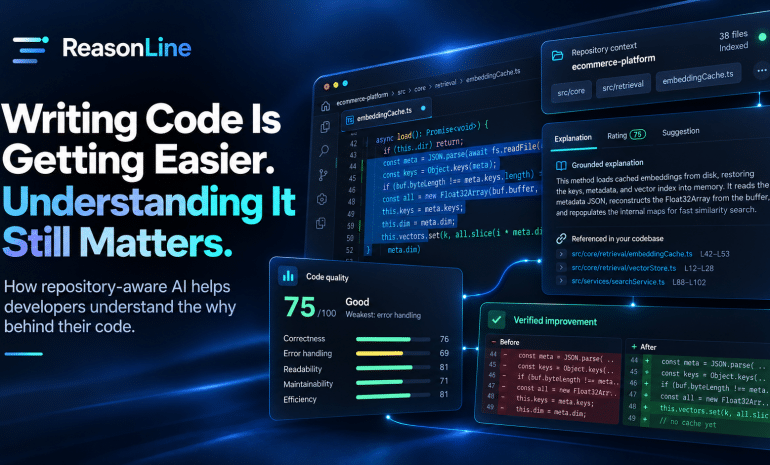
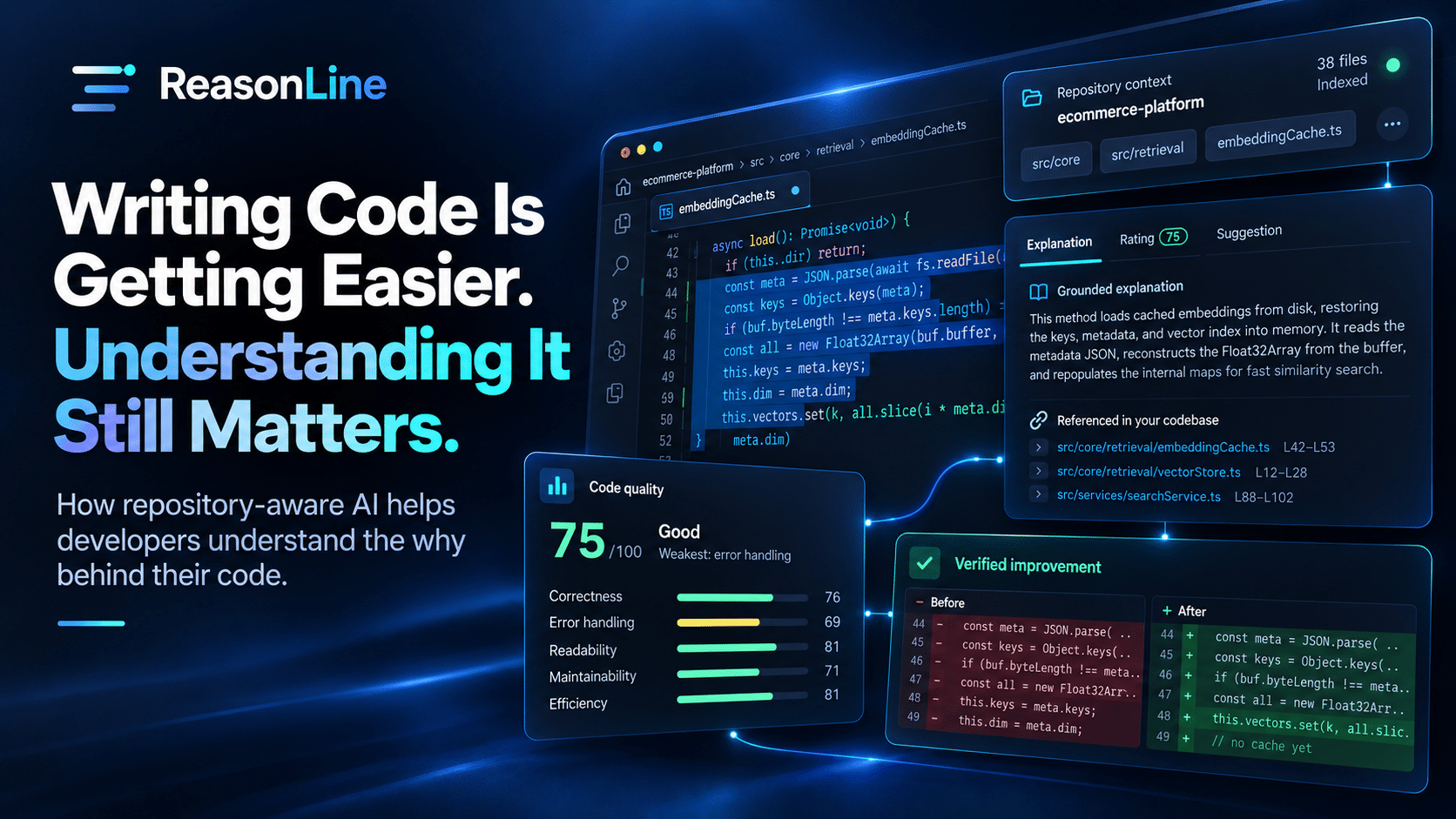
ReasonLine explores a different approach to AI-assisted development by focusing on repository-aware code understanding.
Rather than examining an isolated snippet, it retrieves relevant information from the surrounding codebase to help explain not just what the code does, but why it works the way it does.
Developers can select code and receive explanations of its behavior, related dependencies, and potential areas for improvement.
The extension also evaluates code across several dimensions, including correctness, readability, maintainability, efficiency, and error handling.
One particularly interesting capability is how it approaches suggested improvements.
Instead of generating a refactor and automatically assuming it’s better, ReasonLine evaluates the proposed changes and allows developers to review the differences before applying them.
It’s not a replacement for testing, code reviews, or engineering judgment. It’s another tool that can help developers make more informed decisions.
And that represents an important part of how we think about AI at eLink.
The goal shouldn’t be to replace a developer’s understanding. It should be to strengthen it.
Building Smarter, More Efficient AI Systems
Another important consideration in adopting AI is efficiency.
As businesses begin integrating AI into more of their applications and workflows, the cost and performance of these systems become increasingly important.
A powerful AI solution isn’t necessarily an efficient one.
Every additional request, unnecessary piece of context, or expensive model interaction can contribute to increased operating costs and slower response times.
ReasonLine provides an interesting example of what’s possible when efficiency becomes part of the architecture.
In one demonstration, an analysis completed in approximately 3.6 seconds at an estimated API cost of just $0.0011.
Actual performance and costs vary depending on the complexity of the code and the information being analyzed, but the example highlights an important principle.
Getting better results from AI doesn’t always require bigger models or more expensive infrastructure. Sometimes it requires a smarter approach to how information is retrieved, processed, and evaluated.
This philosophy extends well beyond developer tools.
Whether we’re building web applications, modernizing existing software, integrating third-party services, or exploring AI-powered functionality, thoughtful engineering can have a significant impact on performance, scalability, and long-term operating costs.
At eLink, these are the kinds of considerations that influence how we evaluate technology and approach software architecture.
Making Innovation Accessible
One of the exciting things about the current pace of AI development is how accessible sophisticated technology has become.
Tools and capabilities that were once available primarily to large organizations can now be explored by individual developers and smaller teams.
ReasonLine is an example of that accessibility.
The extension is available free of charge, with developers supplying their own API keys and paying only the underlying API usage costs. There are no additional subscription or usage fees associated with the extension.
There are also plans to make the project open source.
While ReasonLine is an independent project rather than an eLink Design product, it reflects the kind of technical exploration and experimentation that helps drive fresh ideas in software development.
Innovation doesn’t always have to begin with a massive project or a complicated business problem.
Sometimes it starts with asking a simple question:
Is there a better way to do this?
The Future of Software Development at eLink Design
AI is going to continue changing how software is designed, developed, tested, and maintained.
There’s little doubt that development workflows will become increasingly automated and that developers will have access to tools capable of handling much more complex tasks.
But we don’t believe the future of software engineering is simply about generating more code with less human involvement.
We believe it’s about using technology to make better decisions.
That means helping developers understand existing systems, identifying potential problems earlier, evaluating changes more carefully, and reducing the time spent piecing together information scattered throughout an application.
For businesses, this translates into something much more meaningful than faster development alone.
It means software that’s easier to maintain, more adaptable to changing requirements, and built with long-term reliability in mind.
At eLink Design, we’re excited about what AI makes possible, but we’re equally focused on ensuring that the technologies we adopt solve real problems and deliver meaningful value.
Because at the end of the day, writing code is only one part of software engineering.
Understanding why it works, how it fits together, and how it will evolve is what allows us to build software that lasts.
Explore ReasonLine
ReasonLine is available as a free extension for Visual Studio Code and Cursor.
For developers interested in exploring repository-aware code analysis, explanations, and evaluated improvements, you can learn more on the Visual Studio Code Marketplace.
Explore ReasonLine on the VS Code Marketplace